Wednesday, May 31, 2017

Acadia, Chicago

Acadia, Chicago, 5/10/2017 (5-Course, $115 excl. Taxes & Grat.), American Progressive, Michelin 2-Star

Acadia is a Michelin 2-Star restaurant in the south loop of Chicago. Going thru the list in alphabetical order, it is the 1st Michelin 2-Star that I came across. Chef Ryan McCaskey focused mainly on American Progressive theme. The place is elegantly decorated, however, without open or see-thru kitchen.

I ordered a 5-course tasting menu. I started with Amuse Bouche.

1). Lobster Roll -  Fine quality lobster from Penobscot bay in Stonington, Maine, served with mayonnaise and chive sandwiched in a bite-size bread. The cold and clean water of Penobscot bay is the perfect environment for producing the sweetest lobster.


2). Fried Head Cheese – with aioli cream drop on top touched with a sprig of parsley leave.


3). Truffle Cookie -   this cookie dough also had Parmigiano cheese and thyme. It was served like a sandwich with truffle Bavarian cream in between. It was bite-size, but I would not mind to have a few more.

4). Beef Heart – Beef heart was slightly seared and grilled to get the flavor. It was almost raw, served with ponzu sauce, hoi-shin sauce, chopped peanuts, white onion; adorned with Thai basil, mint and broccoli leave. 

1st Course – Truffle Croissant


I noticed the croissant had 2 different colors on the skin, it was made with 2 types of dough and twirled together at the final stage before baking, the darker color dough was the one with chopped truffle and the lighter color was the one plain. It was accompanied by egg custard foam (lighter than egg custard) made of whole egg, vanilla and truffle. I dipped croissant into the custard foam and could not quite find any better terms to describe the taste and flavor besides “It was like in heaven”.

2nd Course – Columbia River Salmon, Fava Bean


Salmon, from Columbia river, was poached to perfection, tender and medium in the center. To complement the flavor, the dish also included fresh radish, toasted granola, tangerine leaves, fresh dill, pickled orange peel, cute pansy flower and lemon yogurt cream.

3rd Course – White Asparagus, Iberico Ham, Farm Egg


I was happy that white asparagus was on the menu again. White asparagus, from Holland considered the best quality, was served with Iberico Serrano ham from Spain. Egg from Slaga farm south of Chicago was low-heat poached en sous-vide to a condition that the egg was barely settled, but not soupy, with a very pleasant rich taste. In addition, there was Fontina cheese fondue, ham crumbles, arugula, water crest, red bean sorrel served with truffle vinaigrette. I loved the taste of this semi-cooked egg yolk, the edge and the center part were with the same softness and smoothness. Most of the sunny side-up eggs was a bit harder on the edge than the center.

4th Course – Stonington Lobster, Ramp Gnochi, Green Goddess


Lobster was from the same source, Stonington, Maine, as what served in the amuse bouche. Lobster was poached in butter to keep its flesh tender and juicy. On the side, there were green gnocchi made of ramp, green asparagus, chervil, thyme, cream and sour cream, lemon and sorrel interspersed with a few cute flowers. The quality of lobster was without of doubt, Chef’s cooking technique also had a lot to do with the luscious taste of this dish.

Red Fife Biscuit, Pretzel Roll – served with 3 flavors of butter, yogurt, mushroom and mixed herbs.


Pea Ice Cream, Japanese Cheesecake, Meringue


For transition to meat dish. Gently flavored pea ice cream was served with whipped light cream and pea leaves/ vine tips.

5th Course – Anderson Farm Lamb, Olive, Peas


Lamb supplied by Anderson Farm was roasted to medium-rare and served with charred onion, diced and sautéed potato, peas and strawberries. The inclusion of olive tapenade made this dish from a good one to an excellent one.

Bloody Mary – with strawberry sorbet, spiced tomato sauce, celery foam, tomato balls and parmigiano sable. It was a palette cleanser proceeding the desert. It balanced among many different flavors and produced a sophisticated taste. 

6th Course – Rhubarb Strudel, Nasturtium
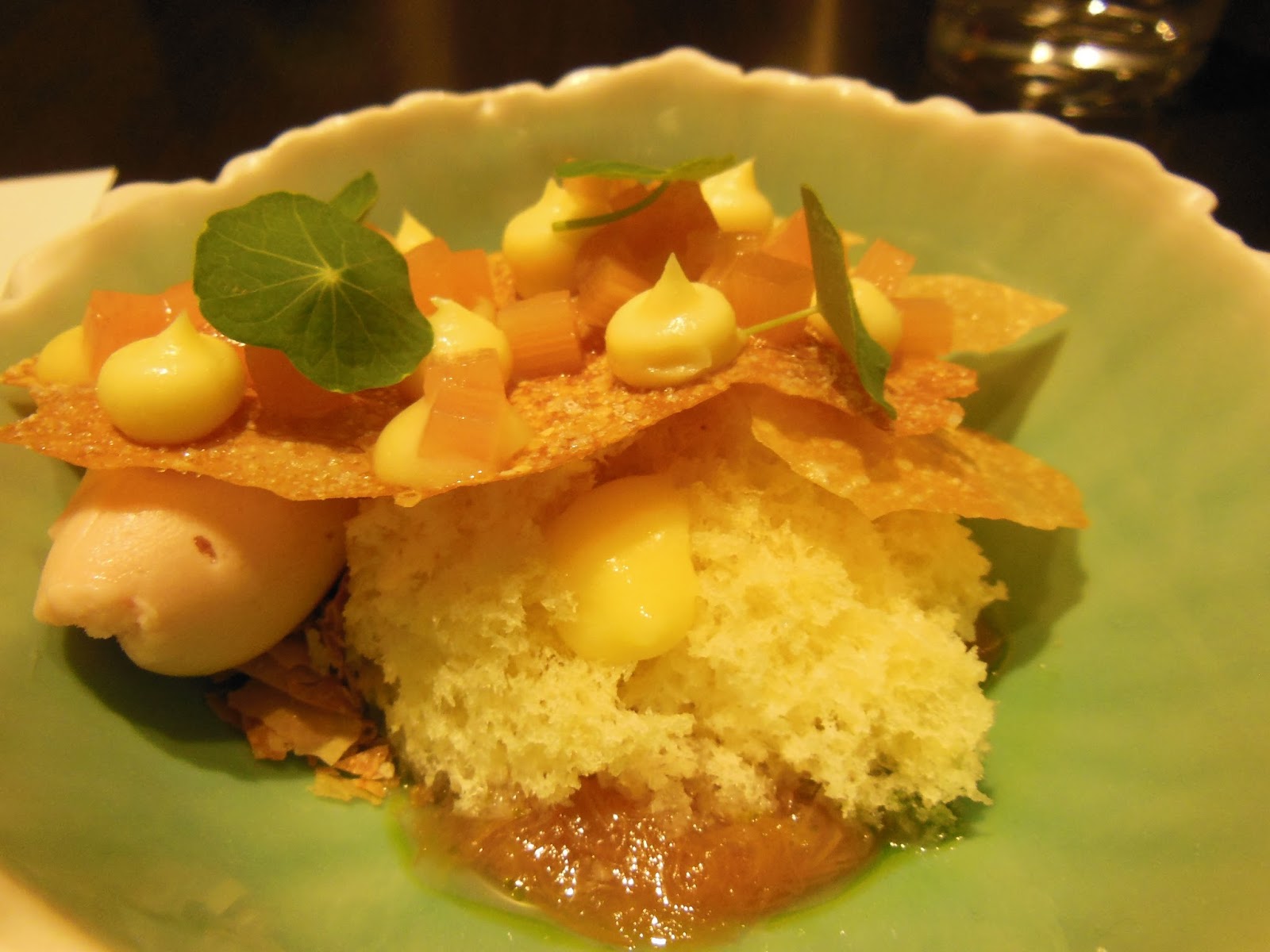


At the bottom, there was a thin crisp with cashew cake, rhubarb compote and ice cream place on the crisp. This 2nd layer was then covered by another layer of crisp which was topped with poached rhubarb pieces, ricotta cheese cream and nasturtium leaves. Rhubarb was prepared properly without the tarry taste. It was a good treat for the seasonal desert.

Petit Four – Raspberry White Chocolate Bon-Bon, Rosemary Olive Cookie, Multi-Milk & Coffee Cream Macaroon. They were all yummy and cute, complementing with each’s distinctive taste and flavor.


After getting off the train at Chinatown station, it took about 10 minutes of walking to get to Acadia. Nevertheless, the mouthwatering experience of truffle croissant made the journey worthwhile.

Boka, Chicago

Boka, Chicago, 5/8/2017 (8-Course, $120 excl. Taxes & Grat.), American Progressive, Michelin 1-Star 

I stayed in Chicago for a week to enjoy its fine dining and fine arts. I arrived on a Monday with very limited opportunities for fine dining choices. For some strange reasons, most of the Michelin 3-Star and 2-Star restaurants are off on Sundays and Mondays or Mondays and Tuesday. I chose Boka because of its vicinity to the hotel.

Boka offered an eight-course tasting menu. I started with Amuse Bouche.

1). Kumamoto Oyster, Togarashi, Celery 

Kumamoto oysters are native to the southern islands of Japan. Kumamoto oysters grow very slowly and have a rich taste that feels like eating real butter for the 1st time in your mouth. In addition, the meat filled the shell pretty full. These days, they are mainly produced in Puget Sound and Willapa Bay in the northwestern part of US. The size was not large, but the meat was rich, smooth and fresh. Served with Japanese chili oil, and finely diced celery, it was ideal for opening your palette.

2). Pumpernickle Pain Perdu, Horseradish

 Maple syrup marinated trout roe sat on top of pumpernickel bread to balance the salty taste of fish roe. Then, fresh grated horseradish and chive were placed on top of trout roe to provide the whole item with a more sophisticated taste.

3). Crispy Cod Skin, Smoked Eel, Black Garlic

There was creamy black garlic ayoli at the very bottom, topped with finely grounded crispy cod skin. House made smoked eel was placed on top of cod skin which is then covered by a thin layer of daikon and a micro green for decoration. 

The three items of amuse bouche were awesome. I love good amuse bouche which usually indicated the chef’s style and to be finalized product in progress.

Breads were served, including freshly baked pretzel bread with caraway seeds and salt, and whole wheat bread. Butter was served with lemon zest. Both bread and lemon zest made pleasant appetizing aroma.

1st Course – Scallop Crudo, Almond Milk, Horseradish

This was a quasi-sashimi style scallop. However, the flavoring was different. This dish was served with almond milk, nori oil (soaking nori in oil for a long time to extract nori flavor). My favorite ingredient was the tiny pale pinky balls squeezed out of finger lime. These tiny balls had such a pungent flavor of citrus, pepper, and a bit of wasabi-like flavor, really hit the spot. It was an excellently well-balanced and pleasantly presented dish.


2nd Course – White Asparagus, Sorrel, Potato, Dried Scallop


Mid-May is the season for white asparagus, my favorite vegetable. This dish is roasted white asparagus with potato (in round shape) in sorrel sauce with sorrel cover. Up to this moment, this could be a very tasty dish already. But, the chef delivered more inspiration, chef made powdered fried potato and powdered smoked dried scallop. These dried powders were dusted on top of asparagus and then decorated with celery leaves. Asian people like to use dried shrimp or dried scallop to enhance the taste of vegetable or rice. I love this chef’s creativity of using dried scallop to bring out a different perspective of taste.

3rd Course – Shaved Foie Gras, Cashews, rhubarb, Celery Root


I saw a lot of shaved light brown flakes when this dish was served. It was shaved foir gras, foie gras was frozen and shaved in a special machine. Shaved foie gras was sprinkled with cinnamon powder and covering rhubarb, cashews bit and celery roots underneath. Since foie gras was shaved into thin flakes, the temperature was low otherwise flakes would be softened. Therefore, to enjoy the full flavor, you should let it stay in your mouth for a few seconds until flavors from all the ingredients were fully integrated at above freeze point temperature. This was the 1st time that I taste frozen shaved foie gras and I was satisfied with the taste.

4th Course – Roasted Octopus, Kumquart, Fennel


1st job was to prepare nori-flavored butter by soaking nori in butter. Then, brushed nori-flavored butter on octopus before roasting octopus. This dish was served with fennel in 3 flavors – roasted fennel, fresh fennel, and fennel purée. It also served dill and kumquart on the side to complement octopus’ enhanced seafood flavor.

5th Course – Olive Oil Poached Cod, Maitake, Peas


Cod filet was prepared en sous vide, therefore, tender and medium in the center. Cod was served with crispy shallot, shallot, sorrel and sorrel fumé (less airy than foam). In addition, there were fresh baby peas, maitake mushroom and mushroom jam (sautéed and glazed with a bit sugary appearance) which did the wonderful job of complementing the fish and bring out a sophiscated overall taste.

6th Course – Roasted Lamb Loin, Beets, Gem Lettuce, Yogurt


Lamb was supplied by Colorado Farm. The dish had various parts of a lamb – loin, neck and tongue. On the side, there were gem lettuce, beet, cooked lamb juice and lamb yogurt (white round shape) which tasted milder than goat cheese.

7th Course – Black Sesame, Strawberry, Puffed Grains, Tonka


This is a course considered a palette cleanser. It included black sesame ice cream, strawberry compote, crumbles (in light brown color) and tonka beans.  

Tonka beans look like an elongated raisin or a hard, skinny date. The taste of Tonka Bean is linked strongly with its scents like vanilla, almond, cherry and cinnamon. Chefs are craving for its spicy and fruity aroma which can be used in both savory and sweet applications. Tonka beans are usually shaved, a preparation to release its pungent aroma and subtle flavor. Unfortunately, all foods that contain the chemical compound coumarin are considered by the FDA to be "adulterated" and have technically been illegal since 1954. Tonka beans are a major source of coumarin, therefore, not available in US in the past. This year, tonka beans seem to be in fashion. Internet has changed the accessibility and availability of many things in the world. Because of its taboo status in the past, creative chefs are eager to play with it.

8th Course – Dark Milk Chocolate, Earl Grey, Sudachi, Black Lime


It included Earl Grey ice cream, dark chocolate ice cream, sudachi jam and some mint leaves on the side. Sudachi is a sour Japanese citrus, not eaten as fruit but used as a food flavoring in place of lemon or lime. It has a zestier flavor and aroma than lemon or lime. I have always liked its taste. The desert would have been more complete if a piece of cake or pastry had been included. However, the inclusion of Sudachi did make the taste and flavoring more interesting.

Petit Four – It had five items. They were all cute and delightfully luscious.


Passion fruit tea cake – bite-size yellow cake with passion-fruit flavor
Chocolate and chia truffle – taste less rich than ordinary truffle
Chocolate and almond dacquoise – with a bit of almond-flavored liquor taste
Chocolate with pistachio and dry fruits – pineapple, raspberry and apricot
Mango jelly candy – very refreshing, I would love to have a few more pieces

Boka’s savory dishes were extraordinarily above average of the Michelin 1-Star restaurants’ quality. I really enjoyed my 1st fine dining in Chicago.

Tuesday, May 30, 2017

Grace, Chicago

Grace, Chicago, 5/9/2017 (9-Course, $235 excl. Taxes & Grat.), American Progressive, Michelin 3-Star

Chef Curtis Duffy interned in Alinea, another Michelin 3-Star restaurant in Chicago, before he established Grace in the “thoughtfully progressive” style with every dish displaying individuality, located in West Loop of Chicago. I was not able to make a reservation at Alinea because its unfriendly and biased reservation policy toward “single”, one-person booking. The receptionist at Alinea acknowledge that 2 out of 3 menus do not accept “single” reservation and the one menu which accepts “single” would take one reservation/per evening at 8pm seating only.

There were 2 types of menu, Flora (highlights vegetables) and Fauna (focuses on seafood and protein.) I chose Fauna menu.

Amuse Bouche – 2 Courses

I). An irregularly-shaped platform made of bee wax was used to present 4 items of amuse bouche.

1). Cotton candy was used as a holder for house-made granola and dry blueberry. Black powdered-leek were sprinkled on top of cotton candy and a piece of basil covered the top. During this trip, I found out Chefs in Chicago like to include grains in cooking. Its house-made granola tasted well with cotton candy. 

2). Dried beets (larger thin red sheet) used as a place holder, with Umeboshi (Japanese pickled plums) in the center with chamomile emulsion and tarragon.

3). Jamón Ibérico is a gourmet specialty made exclusively from black-hoof pigs fed mainly by acorn from century old oak trees, imbuing ham with delicate and unique flavor that that thrills the senses. It is one of the Spain’s most highly prized delicacies. It was served with chick pea and butter cream.  

 4). A bite-size of panisse with fava beans and Myer lemon cream.


II). Guinea Hen, Ramp, Radish, Chive Blossom - It was brought to the table with tightly sealed foil on the top. As it settled on the table, my server lifted the sealed foil to let out Applewood smoke. Under the foil, it was coconut and lemongrass cream. Inside the glass bowl, there were radish, pickled radish, white chive flower, crispy panko, boned roasted guinea hen, scallion, ramp, green cream (from green onion) and coconut and lemongrass cream like what under the foil. This is a very sophisticated dish with many ingredients and different methods of infusing flavor. It was my 2nd favorite dish in this meal.


1st Course – White Asparagus, Burgundy Oxalis

Mid-May is the season for white asparagus, my favorite vegetable. Burgundy oxalis was often used for its burgundy foliage and white/yellow flower. White asparagus was poached and served with fingerling potato, topped with Osetra caviar. Scallion oil (green dot) was served on the side and julienned scallion and chive were placed on top of caviar. White asparagus was cooked differently from how it was done at Boka.

2nd Course – Alaskan King Crab, Sudachi, Cucumber, Lemon Mint


This has been Chef Duffy’s signature dish. Crab meat was served in cucumber dice and cucumber juice in the bowl. Organic trout roes were served on top of crab meat. In addition, sudachi (Japanese lime) cream (yellow) and coconut lemongrass cream (white) and Fresno red pepper curls and lemon-mint leaves were also contributing to the flavor. On the very top, the bowl was sealed by a thin slice of transparent candy sheet. Once it was served, guest had to break open the candied sheet before reaching into the bowl. Using sudachi’s more zestier aroma and flavor in this dish was certainly a seamless choice for a perfect signature dish.

Three types of bread were served – Semolina with fennel, roasted potato with dill, Hawaiian pretzel with sea salt. Each of them were two-bite size, accompanied by 7 different flavors of butter - original, red basil, parsley, tarragon, dill, chive, mint.


3rd Course – Bay Scallops, White Poppy, Romaine, Nasturtium


Slightly poached scallop was placed on top of shallot and onion marmalade. In addition, red nasturtium, scallion, green lettuce leaves, romaine lettuce, flower, pickled onion and shallot were served along with white poppy seed milk. On the very top, there was a thin layer of dashi sheet, jello made of dashi broth (made by heating kelp, fermented and preserved tuna, or shitake in hot water.) It was a quite interesting dish that Chef Duffy used dashi flavor to enhance scallop’s seafood flavor, on the other hand he used other ingredients to neutralized seafood flavor.

4th Course – Red Kuri Squash, Duck, Chocolate, Sunflower Sprout


Duck confit was served with brioche, sun flower seed powder, chocolate, sun flower seed chip, sprout, apple, and duck fat de-hydrated. Apple and squash soup was served lastly at the table. French prepare duck confit with a long process of curing, poaching at low temperature for 4-10 hours, and then preserved in duck fat to get the rich taste. I did not know this was duck confit, as it differed from the authentic French style, until the server pointed it out.

5th Course – Pork, Gnudi, Porcini, Spinach


Braised pork cheek to the extent, it almost melted in your mouth. It was accompanied by gnudi, made of semolina and ricotta cheese instead of potato, with excellent texture. On the side, there were spinach ball, crispy red cabbage, tropical spinach, diced pancetta and the very tasty fennel coriander sauce. I cook pork shoulder almost in a similar way except that I used a bit of anise star while chef Duffy did not.

6th Course – Miyazaki Beef, Grains, Hon Shimeji, Kaffir Lime

Miyazaki beef from the Miyazaki prefecture of Japan is a “A5 Wagyu”. Ever since I had Kobe beef in Japan 13 years ago, I have been longing for a real or quasi Kobe in US. I had it in Grace finally. It was melt in your mouth type, served with basil and coconut, grain purée made of black and white barley, basil leaves, dill, coriander seed (in the middle), hon-shimeji mushrooms and black garlic cream. Beef was perfect, on quality and flavor. It was quite interesting that Chef Duffy cut the beef, not vertically or splitting horizontally, but diagonally which enabled a different way of tasting flavor and texture. This course, without of doubt, was my favorite dish for the evening. Whenever I think of Kobe beef, my mouth would start watering.

There are some grades for WAGYU beef, and A5 is the highest grade given only to the finest beef. It is famous for its smooth velvety texture, juicy flavor, delicate but rich taste. Its appearance looks marbling, tiny pieces of fat finely distributed. Marbling is never too rich, it almost melts in your mouth. The marbling is also the evidence that cattle have been specially raised in the vast lush wilderness using carefully selected feed (corn and rice straw), pure water and clean air.

Beef is classified into four categories, Japanese black cattle comprised the largest number of 4 breeds. Its deliciousness consists of the following factors: the taste and flavor that spread out in the mouth, and the smooth texture. The standards of grading beef consist of yield grade and quality grade. “A” of “A5” means the yield grade and “5” of “A5” means quality grade.

I was fortunate to have A5 again on 5/11/17 at Oriole, Chicago. Chef at Oriole prepared A5 Wagyu in another interesting way.

7th Course – Blood Orange, Vanilla, Fennel


This is the palette cleanser before the real desert was served. Main component was refreshing blood orange ice with vanilla cream on the side and fennel leaves on top.

8th Course – Huckleberry, Honey, Fenugreek, Basil


Fenugreek cake (green) was served on top of huckleberry ice cream (red), huckleberries were on the side. Meringue, accented with pepper and fenugreek seeds, was sitting on top of ice cream for decoration. Fenugreek is an annual plant with leaves consisting of 3 small obovate to oblong leaflets, brought into cultivation in the Near East. Fenugreek is used as an herb (leaves), spice (seeds smelt and taste somewhat like maple syrup) and vegetables (leaves and sprouts). It is similar to clover that is native to the Mediterranean region, southern Europe and Western Asia. However, fenugreek has high content of coumarin-like compounds and may interfere with the activity and dosing of anticoagulants. It is important to inform the restaurant if you have any special health issues (allergy or pregnancy) as some of the ingredients used in the meal may have side effect.

9th Course – Cashew, Cocoa, Crème Fraiche, Hoja Santa


Hoja Santa is an aromatic herb with a heart-shaped, velvety leaf which grows in Mesoamerica (Northern S. America to Mexico, southeastern Florida and California.) The name Hoja Santa means “sacred leaf”. The complex flavor of Hoja Santa is not so easily described; it has been compared to eucalyptus, licorice, anise, nutmeg, mint, tarragon and black pepper. The arrival of internet era has provided chefs with accessibility and availability of more varieties of spices and ingredients for more creativity and experiment. While some of the chefs started using “Tonka”, chef Duffy also used Fenugreek and Hoja Santa to advance his creativity and experiment.

This desert included chocolate mousse (elongated shape), chocolate jell (round shape), chocolate curls and pieces of chocolate cake. On the side, Hoja Santa was presented in 3 different forms – drop (sitting under cashew), leaves and cream (on top of chocolate jell.) This is quite an intricate combination yielding a sophisticated taste.

Petit Four – a little yellow ball

It was a showmanship of the latest molecular gastronomy by using cocoa butter into the spherification process (by dipping sodium alginate into calcium lactate.) Since coca butter contains mainly fat which turns hard in cold temperature and melts in warm temperature. This cute little yellow ball was filled with apple cider and dipped into nitrogen at below “0” temperature before serving. I have watched it thru out the dinner from where I was sitting. The yellow ball was placed on a long wooden spoon to avoid direct human contact. The server suggested to put the whole piece into my mouth and closed my mouth fully. After a few second, I could feel the bursting of apple cider coming out of the shell. It was a pleasant experience.

Dining in Grace is a phenomenal culinary experience. I sat at the table closest to the open kitchen (with glass wall), therefore, was able to observe most of the activities there. The restaurant had an “expeditor” just to make sure the flow of orders was timely. In addition, Chef/owner Duffy was in the kitchen a few times to ensure works were done properly with desired quality.