Monday, June 18, 2018

El Celler de can Roca, Girona


El Celler de can Roca, Girona (€180, 5/23/2018, 7-Course incl. VAT)

This was my 2nd visit to Roca since 2014. I was so delighted with my previous experience that I decided it was worthwhile to make another visit, a detour from Barcelona. Roca, currently jointly owned by 3 chefs/owner/brothers Joan (executive chef), Josep (head sommelier) and Jordi (pâtissier), has had 3 stars since 2009.

Roca, has been staying low-profile regardless of its outstanding cuisine, creativity, presentation, cooking methodology and molecular gastronomic techniques. One of the popularly used cooking devices (Roner to enable controlled temperature, sous-vide) was invented by Joan Roca and Narcis Carner (henceforth the name Roner).

There were 2 sets of Tasting Menus, the Classic and the Feast. Since I have had a few fine dining before Roca’s and 3 more afterwards, and this is my 2nd visit to Roca, I knew that Roca offered a lot of appetizers (not indicated on menu when you made your choice of menu), I decided to choose the smaller menu to give my stomach a bit breathing room. There were 2, among 7, courses allowing guests to choose from 2 choices. My server was very knowledgeable and very kind, she suggested to have the ½ portion of each item.

Appetizers

I. I started with The World, A Typical Tapa Made with Current New Technique


Thailand:     chicken, coriander, curry, nut (peanut), mint, onion, lime

Japan:         croquet with miso sauce, ginger on top

Turquia:       braised lamb, yogurt, chive, onions with mint, lime

Peru:            Causa limeña, potato with olive, paprika, avocado, tomato and yellow paprika

Korea:          panko fried bread, bacon with soy sauce, kimchi, mint and sesame oil

It was sophisticatedly presented in a globe set like what you saw in the library. Appetizers associated with Turkey, Peru and Korea were properly aligned in sync with the respective country. I was asked to guess which a Japanese appetizer was and which a Thailand appetizer was, then pull a lever. Once I correctly guessed and pulled the lever, the top dome opened up. There was a serendipity, a sea water bonbon. Roca made eating a playful act as well, I wish they would do more.

A Sea Water Bonbon   a Salmon caviar and Beluga caviar jelly ball. What a nice surprise.


II. Memories of a Bar in the Suburbs pf Girona

This course was a Can Roca-themed past time, with black and white photos of each Roca brother when they were young.


1). Campari Bonbon  Orange bonbon made with gentian (from Catalan) and orange juice. Gencian is a type of medicinal plant from Catalan, it can used for various medical purpose such as healing sore throat and cold, ulcer or skin problems. This recalled my experience at Mugaritz of eating beef tartar with penicillin.

2). Squid  It was a raw calamari sandwich with fried bread. Calamari was fresh and tender, from the nearby Costa Brava.

3). Montse’s Meat Cannelloni  It was a tiny version of cannoli, its shell was made with onion and cheese. It was filled with pigeon parfait in a roll and topped with parmigiana cheese and cheddar cheese.


4). Pork Kidney  Pork kidney with sherry and dried in lyophilization (freeze-drying) machine (one of the new technique invented by Roca). Dehydrated kidney looked like a peanut and tasted with an earthy flavor.
         
5). Cod Brandade  Cod fish purée, cod from Norther Spain, with pine nut, chili green pepper served on a shell made by dried and fried puffy cod skin. Chili added a touch of smokiness and a contrast-harmony interaction of flavors and textures.

III. The Ocean, Presented in a Gold Coral-Shaped Serving Apparatus

1). Pesto Razor Clam  Semi-raw razor clam was served with pesto sauce and fresh basil leaf. It was simple and well-balanced.


2). King Crab with Its Coral  Crab meat was served with crab sauce, fennel leaf standing in the middle. I wouldn’t mind to repeat “The Ocean”.

3). Starfish  A starfish shaped mousse was served on a thin cracker, on a plank. Starfish was made from prawn mousse, topped with green seaweed and red seaweed and sesame. Chef made prawn mousse with such a distinctive flavor, probably by using head or leg crumbles.

IV. Olive Tree – Green Olive’s Ice Cream and Black Olive Tempura  Green olive ice cream were frozen ice cream, flavored and shaped like olives, and then hung delicately on an olive tree. Each olive came on a tiny silver spike, engraved with the Roca’s signature “R” with three feet, one for each brother. Each olive offered a pungent cool olive flavor. I wonder these bonsai olive trees were the same group that Roca used when I made the 1st visit.


V. Saint George Mushroom’s Brioche  St. George’s mushroom is a delicacy that mainly grows in fields and roadside. It is a popular item in Northern Spain, Southern France and the Basque country (perretxiko in Euskadi), appears only in April and May.  A moisture brioche with St. George’s mushroom mayonnaise filling, topped with summer truffle. It was light, creamy and tasty that I wouldn’t mind to have a few more.


These bite-size appetizers were all with the adorable presentation and their flavor and taste was just as good as they look. They also got the taste bud going.

1st Course - a).White Asparagus and Truffle Viennetta

One of the reason I chose this menu was its inclusion of “White Asparagus Viennetta”. I have longed for it ever since I had it in 2014. It was a white asparagus dish made to look like Viennetta ice cream (or Comtessa as what is called in Spain). Creamy white asparagus ice cream was served with black truffle powder, white summer truffle and mustard green. The ice cream had a wonderfully smooth consistency and the subtle and smooth taste of white asparagus flavor was sensational, a true essence of white asparagus.

1st Course - b). Apple’s Timble and Duck Liver with Vanilla Oil

Foie gras covered by caramelized thinly sliced apples. Caramelized apples were arranged in a donut shape with apple cream in the center. In addition, Spanish flag flower (in red), Shiso (in green) and sliced almond were in the center for decoration. Pedro Ximenes sweet wine reduction (in brown circle) and caramelized apples both complemented the taste and the balance.

Roca offered a good selection of breads. I chose olive brioche, red wine bread and apricot  raisin bread.

2nd Course - Prawn Marinated with Rice Vinegar - Prawn’s Head Sauce, Crispy Prawn Legs and Seaweed Velouté

Palamos red prawn was marinated in rice vinegar and served with dried and fried salty prawn legs, orange sauce (head of prawn), green sauce (seaweed velouté) and lemon caviar (pearls in spheres). Palamos prawns is a registered product from nearby Costa Brava where you can see the seabed in the beautiful clear blue water. The taste of this dish was sublime, prawn was almost raw, you can taste the tender flesh and flavor of a juicy raw prawn. Prawn’s head, with its concentrated prawn flavor, was probably a major contributor to the flavor.

3rd Course - Charcoal-grilled Langoustine with “ajoblanco” Sauce and Parsley
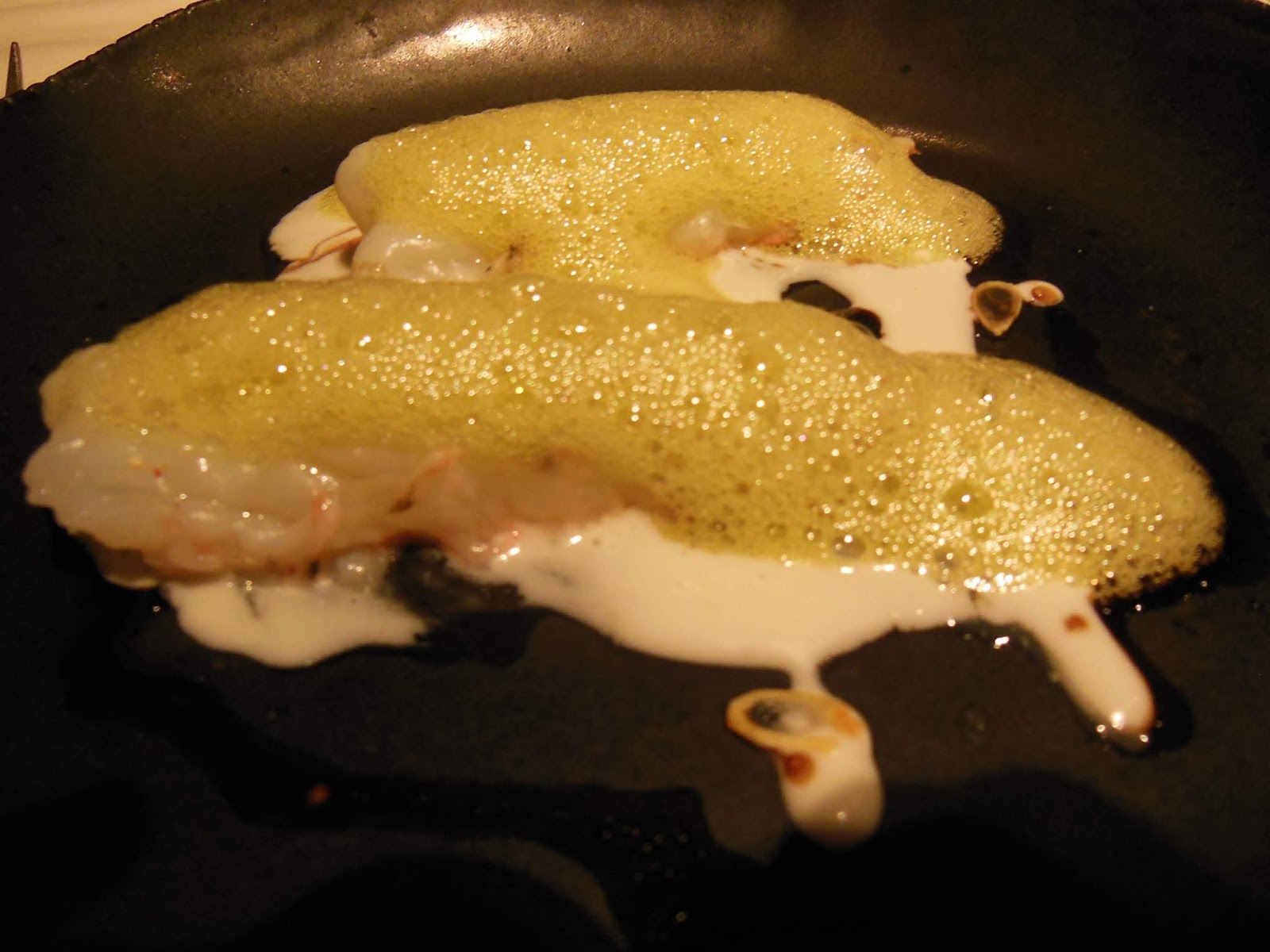

Langoustine was charcoal-grilled for its charcoal flavor. It was still almost raw, the best way to taste the fresh and quality seafood. It was served with toasted almond slices, garlic, olive oil sauce (in white color) and parsley foam. It was another wonderful seafood that I wouldn’t mind to have another serving.

Additional photo for a comparison of lobster with langoustine.

4th Course - Sole with Olive Oil, Fennel, Bergamot, Orange, Pine Nut and Green Olives

Mediterranean baby sole grilled and accompanied by 5 different types of sauce: 1) fennel sauce and fennel (in green color), 2) bergamot sauce and flower (in pale yellow), 3) orange sauce with confit orange skin, 4) pine nut cream with pine nut, and 5) olive sauce with olive Catalan style. This dish resembles the style of “mackerel”. Chef Roca can make a very simple dish sophisticated and with marvelous presentation.

5th Course - a). Iberian Suckling Pig a la Rioja: Pear with Cinnamon, Persimmon with Vanilla, Orange with Clove and Liquorice with Cocoa

This piece of suckling pig definitely looked very different from the one that I had at “Coque” in Madrid. Coque’s looked like there was a pocket in between skin and meat.

By looking, I could tell that there was a crisp crackling on top and juicy and tender meat underneath. This was a loin part of pig. Pig was first roasted at low temperature at 63°C for 32-36 hours, then grilled at high temperature at 220°C until the skin is crispy enough. It was accompanied by various types of sauce: strawberry with cocoa, pear with cinnamon, confit pear, shiso, cocoa, liquorice, persimmon with vanilla, orange with clove. This piece of appealing sucking pig was sitting on the reduction of roasting pig’s stock. It looked very appetizing, it was well-balanced with sweet flavor. Chef Roca has taken the art of “suckling pig” to another level.

5th Course- b). Goose a la Royale

Chopped roasted goose and liver were made into a mold. It was served with foie gras sauce and reduced roasted goose’s stock. I don’t eat goose often. But, I definitely like the suckling pig more.

6th Course - Orange Colorology


Orange colorology, in a glass bowl, made mainly with orange colored products, including little sorbet balls (shorts) of orange, apricot, mango, passion fruit flavor and edible flowers. One of the most beautiful and adorable desserts that I have ever had, served on a decadent golden hued plate.

It was a glass bowl made with Isomalt sugar. Isomalt is a sugar substitute, a type of sugar alcohol used primarily for its sugar-like physical properties. It has little to no impact on sugar levels and does not stimulate the release of insulin.  In addition, it can sustain high temperature up to 165°C. Chef can dissolve Isomalt sugar and then blow bubble to the desired size, then make an opening of any size and configuration on the mold. After the sugar bowl is cool, filled it up with all the goodies you like. Lastly, turn this lovely bowl upside-down and serve to the guest. You bet, everyone will love it. Can you believe this Isomalt sugar hardly has any calories?

In my sugar bowl, there were apricot shorts, mandarin orange shorts, mango shorts, passion fruit shorts, egg yolk cream, orange flower, red flag flower, purple flower (orqidera = orchid), yellow flower (thought flower), and orange flower foam. I cracked it open when I was ready to eat it. It was a true pleasure to see it esthetically and to enjoy it gastronomically.

7th Course - Large Chocolate Bonbon


Chocolate bonbon is a chocolate ball made with chocolate crust, almost the size of sugar bowl that I had in the prior course, covered by gold foil (edible gold) and flanked by 2 pieces of chocolate brioche. Inside the chocolate bowl, it was filled with chocolate mousse, milk chocolate shorts, dark chocolate shorts. It was chocolate galore.

A good selection of sweets, chocolate, macaroons were presented in the restaurant’s dessert trolley designed by Andreu Carulla. The varieties included violet macaron, whisky tart, chocolate with lemon, chocolate with amaretto, chocolate with hazelnut, red fruit with marshmallows, praline walnut, Peruvian seeds, liqueur filled cherry, pineapple and coconut candy. At this time, my eyes were bigger than the available space in my stomach, I wished I could have more but a few of these delicacies.


Roca offers the best value in terms of price/quality & quantity comparing with other fine dining in Europe. El Celler de can Roca has been one of my favorites ever since I visited it in 2014. After this 2nd visit, I liked it even more. Will I go back to it for the 3rd time? I definitely would like to in the future.

Sunday, June 10, 2018

Disfrutar, Barcelona


Disfrutar, Barcelona, 5/22/2018 (€185, 33-Course incl. VAT)

Disfrutar means “enjoy” in Catalan. It was started by 3 alumni of el Bulli - Oriol Castro, Mateu Casañas, Eduard Xatruch, and received its 2nd Michelin star this past year. It has a very modern style of interior design which has won an interior design award this past year. As you walk thru the bar area, with some seating, you will see the dining area with high ceiling and hung objects for decoration. It also has a courtyard to offer outdoor dining when weather condition allows.


There were 5 sets of Tasting menus and I chose the most comprehensive one for a 3 ½ hours dining.

I.
1st Course - Frozen Passion Fruit Lady Finger with Rum


Passion fruit foam, frozen powder pepper mint and rum sauce. Obulato is a clear film, it disappears in contact with water but holds oil. It was originally used in Japan for candy wrapping or medicine. Techniques were further developed at el Bulli to create very thin and delicate wafers but with more strength. These wafer-thin edible sheets made from rice or potato starch can be used to create beautiful garnishes which melt in the mouth. Obulato thin semi-transparent layer can be combined in thousands of different ways with other ingredients into other forms and into various flavor. It is an ideal play toy for the molecular gastronomy. It can be strengthened by making more layers and then get dehydrated slowly or baked at low temperature. Three Chefs/owners of Disfrutar have mastered their gastronomy skill and technique since their days at el Bulli.

Passion fruit lady finger with rum was delicious with balanced flavor and taste that passion fruit’s flavor was not overwhelmed by rum.

2nd Course - The Best That Comes Out of The Land


Beet root meringue with beet juice with yeast powder. The fun part of serving this dish was lost in the still photo. The glass bowl first looked like a bowl of seeds, after a few rounds of shaking by my server, this stone (cookie) came out to the surface.

3rd Course - Lychee and Roses with Gin


What sitting in the middle rose petal was not lychee, it was white raspberry. White raspberry made look like lychee, with rose petals and rose water, and gin in the spherification. Frozen lychee juice and purée were stuffed in white raspberry to make it like lychee. The presentation was stunning and the taste was so refreshing to wake up your palette.

The end product from molecular gastronomy can be deceiving. The dew on the rose petals were actually encapsulated gin.

II.

1st Course - Panchino/Filled with Beluga Caviar


Panchino is warm, fried-to-order balls of Chinese bread that can be filled with caviar and sour cream or sea urchin. It had a delicately crispy exterior. In my plate, Beluga caviar and crème fraîche were served. At present, most of the time, Beluga caviar are from Chinese-Russian border or Koren-Russian border. They were fresh and juicy, but not as plump as what I had at Da Vittoria.

In addition, the preliminary preparation work for apple cider in the next course started by mixing apple juice with dry ice. A little while later, it became apple cider.


III.


1st Course - Savory Walnut Candy with mango, Tonka Beans and Whisky


10-year old Talisker single malt whisky was used. Caramelized walnut candy was wrapped with obulato sheet and topped with grated Tonka bean to give it a more sophisticated taste.

2nd Course - Smoked Instant Apple Cider


Scenting a glass with burning oak chips, made for an interesting twist on a house-made apple cider. The smoky oak flavor complemented with the earthiness of the cheese.

3rd Course - Idiazabal Mille-Feuille

This was an unbelievably light savory mille-feuille pastry. A biscuit with Idiazabel cheese, smoked sheep cheese was made into fried cheese foam and then used siphon machine to make it fluffier before made into puffy pastry. Candied lemon bit was served on the side to give it a more balanced taste. 

My server informed me that the Barcelona Art & Design School’s students provide well-designed utensils and art objects to the restaurant. This piece used in this course was one of their products. 

4th Course - Multispherical Pesto with Eel and Tender Pistachio


Pesto sauce, cheese cream, pistachio, Parmigiana cheese dices, pine nut, Parmigiana base, pistachio butter, smoked eel, with pancetta on top. This was the good practice of multi-spherical technique, it looked like a green eel.

IV.

1st Course - Gazpacho Sandwich with Vinegar Garnish


Scented garnish was provided by 25-year old aged sherry vinegar in glass, accompanying gazpacho sandwich. Although Gazpacho sandwich looked like bread, but it was not made of flour. It was made of dehydrated tomato meringue. The filling of the sandwich was made of frozen gazpacho sorbet. It was a master piece of molecular gastronomy.

2nd Course - Black Cauliflower with Coconut and Lime Béchamel

My server informed that at present, Korean Ocoo machine can turn food black. It took Ocoo machine 17 hours of continuing cooking at 40-60 degree to turn white cauliflower into black cauliflower. It was a long caramelizing process. Black cauliflower was served with coconut and lime juice, lime bits and reduced cauliflower juice.

V.

1st Course - Crispy Egg Yolk with Mushroom Gelatin


 An organic egg yolk was deep fried with high temperature. It was still soft and running inside. Seaweed and mushroom gelatin was at the bottom. I was instructed, after the 1st bite, to mix the rest of the yolk with the mushroom gelatin that hid below in the egg shell. I would love to have it daily for breakfast.

VI.

1st Course - Liquid Popcorn

Fried corn with tempura coating and corn powder and liquid inside.

2nd Course - Corn Soufflé

A round-shaped fried corn filled with corn grain inside and salt sprinkled on top.

3rd Course - Multi Spherical Tatin of Foie Gras and Corn

It was the practice of multi-spherification with corn. Thin sheet made of obulato at the bottom, with corn (made with multi-spherification) covering foie gras.

4th Course - Ceviche Deconstruction

The outer ring is light brown color was called tiger’s milk, the middle ring in white color was made of fish sauce. First step required was the maceration of fish (hake or cod) and shell fish by lemon, lime, ginger, onion, cilantro, coriander and Aji pepper (from Peru). Then, this flavored liquid was integrated with cream, coriander oil and lime zest and became the fish sauce in the middle ring in white color. In addition, this same flavored stock was further spiced with cilantro oil, spicy Aji pepper, corn and became tiger’s milk in the outer ring. In the inner ring, it was the purée of carrots and tuna. It was all based on ceviche, but with further enhancement in processes and with more potent flavor. It was a real master piece.

5th Course - Razor Clams with Seaweed in Salt


 It was cooked with Carta Fata, food grade USDA approved cooking foil. Carta Fata is heat resistant up to 428F, ideal for cooking seafood, meat and vegetables, can be used in regular or convectional oven. Razor was salt-baked, to give it pressure, at 180C for 5 minutes, and then refrigerate overnight. It was seasoned with olive oil and seaweed and seaweed ravioli. Chef used a robust, full-flavored extra virgin olive oil Arbequina which is mostly grown in Catalonia, Spain. Chef also provided 25-year-old aged sherry vinegar for its aroma.  

6th Course - Crispy Seaweed Ravioli

VII.

1st Course - Our Macaroni Carbonara


To make these macaroni, firstly it involved chilled the mode in sub-zero temperature. Then, coated the molds with flavored or non-flavored gelatin before removing these gelatin pastas from the molds. These gelatin pastas can be soaked in Parmigiana cheese broth or Iberia ham stock for a while to enhance the flavor.

It was served with cheese carbonara sauce and grated Parmigiana cheese. If you are a conventional pasta lover, you will find out although the flavor was there, the texture was different. This is one of Disfrutar’s signature dishes.

VIII. 

1st Course - Crystal Almonds


This dish was prepared to emulate white lupine seeds. White lupine seeds contain a high amount of proteins and are used to detoxify and lower cholesterol.

I was informed that “The Almond Series” will be offered to substitute for Wild Hare which I disliked in the original menu. “The Almond Series” can be offered only for about a month time in May/June while the new almonds are available.

There were a few forms of almonds in the plate. Firstly, the crystal looking almonds were the baby almonds in original form. Secondly, light green color of almonds was made by soaking the shell of young almond, macerating the young almond in elder flower vinegar, then infused in gelatin. Thirdly, almonds peeled and slow cooked in Korean machine to tender soft condition. Fourthly, the white color pieces were almond cream. In addition, a preserved cherry and an elder flower was on the side to give almond flavor a boost. All these were served in green sauce made from skin of the young almonds. Chefs made great efforts to make this a very special seasonal dish.

2nd Course – Almendruco

A bite-size almond ice cream.

3rd Course - Tomato Seed Salad with Mango and Tender Almonds


Tomato salad served with fermented mango, mango vinaigrette, fresh mango, basil spheres, mango cream, young almond, tomato gelatin (in transparent square shape) and elder flower.

4th Course - Tomato Polvoron and Arbequina oil Caviar

Polvoron is a type of Spanish bread. This was made into a savory version, from malt and dehydrated tomato powder, with Arbequina olive oil caviar in spheres. This was another showcase of molecular gastronomy.

IX.

1st Course - Sea Cucumber “a la Gallega”

Fresh sea cucumber was from Galacia (a la Gallega) and served in seafood belacan sauce with paprika powder on top. I always love sea cucumber. According to Chinese herbal medicine theory, sea cucumbers help your body to detox and increase its immune system. I have found out that the fresh sea cucumber in white strips are available only in the Northern Spain region.

2nd Course - Langoustine in “Suquet”

Suquet is the traditional Catalan style fish stew. From the left side of plate, parsley form (green color), round shaped potato spheres, langoustine in suquet. Part of sauce was suquet (orange color), on the right-hand side of plate, saffron and aioli (garlic and olive oil) sauce was served.  Langoustine was cooked half-raw and suquet was rich and flavorful.

3). Cappucino “Suquet”

With potato form on top and “suquet” seafood bisque at the bottom.

X.

1st Course - Hare and Foie Gras Bonbon

Hare and foie gras bonbon (cookie) was served with cold dehydrated strawberry in the black plate.

XI.

1st Course - Squab with Cold and Hot Semi-dehydrated Strawberries

Squab with roasted squab sauce, served with cold dehydrated strawberry and dehydrated, cooked and glazed strawberry with shiso. Squab was rare, tasty and tender. This was the last savory dish.

XII.

1st Course – Pandan

When I saw the sponge cake looking item in the plate, I recalled the 1st time I saw it at Norma, Copenhagen a few years ago. It involved a lot of molecular gastronomy. Even though it looked like a large piece, all you needed was a table spoonful of the ingredients.

Pandan has long green shiny leaf, from Malaysia. Center item was mango sorbet which provided the chief function of palate cleanser. The sponge cake was made by coconut milk, then used siphon machine to pump a lot of air into it. At serving, coated it with cocoa butter and pandan infusion. It must be fun to make it.

2nd Course - Black Sesame Cornet

It was like a little black sesame ice cream.

3rd Course - Cherries 2017


It was a showmanship of the latest molecular gastronomy by using cocoa butter into the spherification process (by dipping sodium alginate into calcium lactate). Since cocoa contains mainly butter fat which turns hard in cold temperature and melts in warm temperature. These 2 cute red balls were filled with cherry juice and cherry mousse respectively and dipped into nitrogen at below “0” temperature before serving. Last year, I saw how it was made at Grace’s kitchen while I had dinner at this Michelin 3-star restaurant. Because its fragileness, one was cracked the moment I picked it out of the plate. I got a replacement. A few seconds after I put it into my mouth, the flavor of filling bursting into my mouth. It was a pleasant and refreshing experience.

4th Course - Tarta al Whisky

My server poured a bit of 16-year-old Lagavulin single malt whisky into my palms and I was instructed to “rub” my hands in the scent of this alcohol while enjoying the next few bites. The small bite of hazelnut encased in an amber of sweet sugar and frozen egg custard was delightful, but I can’t say the aroma of whisky enhanced the experience of this dish. Nevertheless, I love yuzu’s potent and refreshing taste.

5th Course - Coffee Swiss Roll & Chantilly Cream


It was coffee and amaretto frozen cube and Swiss roll (meringue roll) filled with apple cream. It was so light and airy, just right for a full stomach.

6th Course -  Cocoa and Mint Cotton

It was mocha mint cotton candy served on an actual stalk of cotton. Cotton candy was made from sugar, water, corn syrup and salt. At present, cotton candy is also being used for making other more elaborate items. Believe or not, you can make it at home without a professional kitchen.

It was interesting to see Disfrutar’s 3 chefs played with their super-refined molecular gastronomy techniques in new application. It was a gastronomic pleasure to enjoy what they are doing is still what they said “deliciousness and harmony will always remain the kitchen’s focus”.