Monday, July 27, 2015

Atera, NYC


Atera, NYC, 7/17/2015, $257 (incl. gratuity and taxes)

Atera, a Michelin 2-star restaurant, has a new chef Ronny Emborg, a Dane from Copenhagen. He was the executive chef in a Michelin starred restaurant Marchal before joining Atera with New Nordic flair and molecular gastronomy style. Some of the preparations are highly technical and with emphasize on visual appeal.

There is only one set of menu available, the Tasting Menu which is comprised of approximately 18-20 courses, including bread, amuse bouches, appetizers, entrées and desserts. There are two seatings available daily, at 6pm and at 9pm. The price includes gratuity, a European practice.

Atera has an open kitchen with U-shaped counter for customer to eat and watch how each dish was prepared.

1st Course, Green Tomato/Juniper

Dark green colored juniper oil in the middle of the bowl surrounded by white powdery iced green tomato juice. At the last minute, server poured tomato juice from the green tomato. It was very refreshing, served as the palette opener.


2nd Course, Herbs and Flowers/Shrimp

I was informed by my server to start with yellow flower then clockwise. The yellow flower was from Nasturtium plant which is a member of cabbage family with edible leaves and flowers. What made this flower unusual was the stuffing in the middle with Whelk Snails from Maine. Whelk Snails inhabit in the Atlantic Ocean, range from a couple inches to 9 inches long with spiral shell. They have slight briny-sweet taste and slight chewiness. Snails were chopped into small pieces and mixed with mayo into paste. It was very delicate and delicious.  Going clockwise, next was French Sorrell, pea flower, agretti, Fava leaf (with good green-taste flavor) and lime mint (with pungent minty and refreshing taste more than the ordinary mint leaves.) This was the 1st time that I have ever tasted agretti, it is a late springtime Mediterranean succulent with very short season. It looks like a cross between fennel fronds, rosemary and grass and it tastes with robust grassy flavor. What made this course unusual was some of these fresh produce are from Atera’s own greenhouse.

On the side in a bowl, emotion of shrimp was served as dip to accompany each flower or leaf. Shrimp was finely grounded and mixed with olive oil into a very thin paste-liquid. It had a distinctive but not overpowering shrimp flavor.


3rd Course, Baerii Caviar/Pistachio, Beer

Baerii Caviar is from Siberia, it is not too salty and balanced well with the sweet Pistachio ice cream and beer foam.

4th Course, Waffle/Cheddar, Truffle

Crispy waffle was made of unbleached flour and placed at the bottom of the stack. Then, a layer of aged Cheddar cheese was spread on the waffle. The next layer was a master piece of work, a layer of fermented mushroom. Since my taste bud could taste something besides cheddar cheese, I asked one of the chefs and found out that the fermented mushroom would take about two weeks of processes. On top of these spread, there were five slices of gorgeous summer truffles. Bravo, this was my favorite item of the meal.

5th Course, Crab/Tomato, Rose Hip, Pansy

Small pieces of fresh snow crab, from Canada, mixed with diced red tomatoes at the bottom of the bowl, covered by a white layer of dome-shaped jelly made of rose hip and milk. As I broke open the jelly, I noticed there was more layer underneath crab meat. It was the unset soft rose hip jelly. Chef Emborg emphasized the elegant presentation of each dish; this one was adorned with a cute piece of pansy flower. This course was my 4th favorite.


6th Course, Golden Whitefish Roe/Green Almond, Sunchoke

Whitefish roe is in beautiful orange-gold color, it looked very appetizing. This golden roe were small and tasted a bit chewy. Roes are fish eggs which are neither cured nor salted. It was served with almond milk, almond ice and crispy sunchoke (in light brown color). It was adorned by the cute green leaf named “ice flower”. The highlight of this course was the fused taste of almond ice and the roe.
 
7th Course, Scallop/Apple, Horseradish

Scallop credo was at the bottom of the plate, with horseradish snow (powdered iced horseradish), Dianthus dill and dill oil. Each ingredient complemented other ingredients and made a perfect overall taste. Credo dish always required some pungent spicy item to enhance the taste. Here, the powdered iced horseradish served the pivotal role of bringing all other ingredient together.


8th Course, Dumpling/Sepia, Uni

It was a cute bite-size dumpling wrapped with an ultra-thin slice of cuttlefish. What wrapped inside were uni, lark and almond butter. Uni was still half-raw, fresh and quite tasty. Lark is something often brings up the taste, but don’t tell that to your family physician.

I had a replacement dish because of the chewiness of cuttlefish slice. It was risotto made with North Caroline rice and egg yolk, with little cute nasturtium flower adorned on the top.


9thCourse, Oyster/Ponzu

Island Creek oyster was served with elderberry and ponzu sauce. It was adorned with Queen Ann flower. The special feature in this course was the warm ponzu sauce. When I visited Tokyo a year ago, I found out that Japanese restaurant in Tokyo purposely raised the dining room temperature and using the body temperature to warm up seafood in the whole process of serving customer. Their way was in contrary to what we practice in US; here we like to make everything cold.  The reason for keeping things a bit warmer was to enhance the flavor of seafood.


10th “Course, Whole Wheat Batard

I was eager to munch on bread by now and was glad the restaurant finally served a slice of house-made sour dough bread. There were two kinds of butter served, one was the regular butter and the other one was butter with brown onion.

11th Course, Razor Clam/Bitter Greens, Miso

Razor clams was poached and diced, served with baby green pea leaves. Sauce was made of foamy brown butter and miso, with beautiful little flower on top. Razor clams were thoroughly cleaned and sweet, they were less chewy than Whelk Clam served earlier in the evening.

12th Course, Sourdough Croissant

A whole wheat flaky mini croissant was served. It was slightly warm when you touched it.

13th Course, Monkfish/Snow Peas

Monk fish was excellently prepared; it was still half-raw in the center and tasted tender. It was with one of the best textures that I have ever had. At the bottom, there were some purple colored snow peas and white currants on the side. White currants were small and looked like little crystal balls. This was the 1st time that I tasted purple snow peas. Purple snow peas had lesser green taste than the green snow peas. Fish was served with orange blossom Sabayon sauce. Orange blossom was not too overwhelming; this course was another perfect inspiration.


14th Course, Onion/Mushroom

This course was comprised of varieties of mushroom, Maitake, milk cap and Chanterelle, and Nasturtium leaves, served with foamy French Oulett cheese sauce. On the side, there was one thinly sliced onion marinated in Champagne vinegar. This piece of onion greatly enhanced the balance of this course.

15th Course, Foie Gras/Black Currant

I dearly loved this course. Warm foie gras topped with chopped roasted peanuts, covered with a red color sheet made of black currant. This sheet was not made of jelly. It was made by dehydrated black currant juice. The flavor was full, not overwhelming but intensive, it was much better than the ordinary jelly often served with foie gras. This was my 2nd most favorite for the evening.


16th Course, Lamb En Croute/Huckleberry, Allium
This was a very sophisticated course with multiply layers of arrangements. Lamb was from a Pennsylvania farm, served medium-rare. It was served in a brioche crust, on casing of brioche. After I started slicing lamb, I realized there was another layer of something on the brioche. I found out, there was a thin layer of chicken mousse topped with burned onion powder. Lamb was placed on top of brioche crust, chicken mousse and burned onion powder and then topped with sliced black kale (in white color looked almost like sliced garlic), onion and red currant. This course was a true master piece. It was my 3rd favorite for the evening.

17th Course, Cucumber/Lemon Verbena

This course was the palette cleanser. Cucumber granite was served with lime meringue. Some lemon verbena leaves and St. Johns Worth were on the side for decoration as well.  Lemon verbena mousse was under the cucumber granite to offer a refreshing taste.

18th Course, Milk/Raspberry, Tarragon

This is the 2nd time that I had cooked potato in desert. The 1st time was at L’Astrance , Paris. At Atera, cooked potatoes were diced and served with raw milk sorbet, then topped with wild raspberry. Wild raspberry had a darker color then ordinary raspberry and had a fuller taste than raspberry. Some clover leaves were on the side of sorbet for decoration. Tarragon sauce played the important role of turning this raw milk sorbet desert into a more sophisticated taste.

19th Course, Chocolate Cake

I got a complimentary cake, with chocolate glazing and milk chocolate mousse inside.

20th Course, FlØdeboller

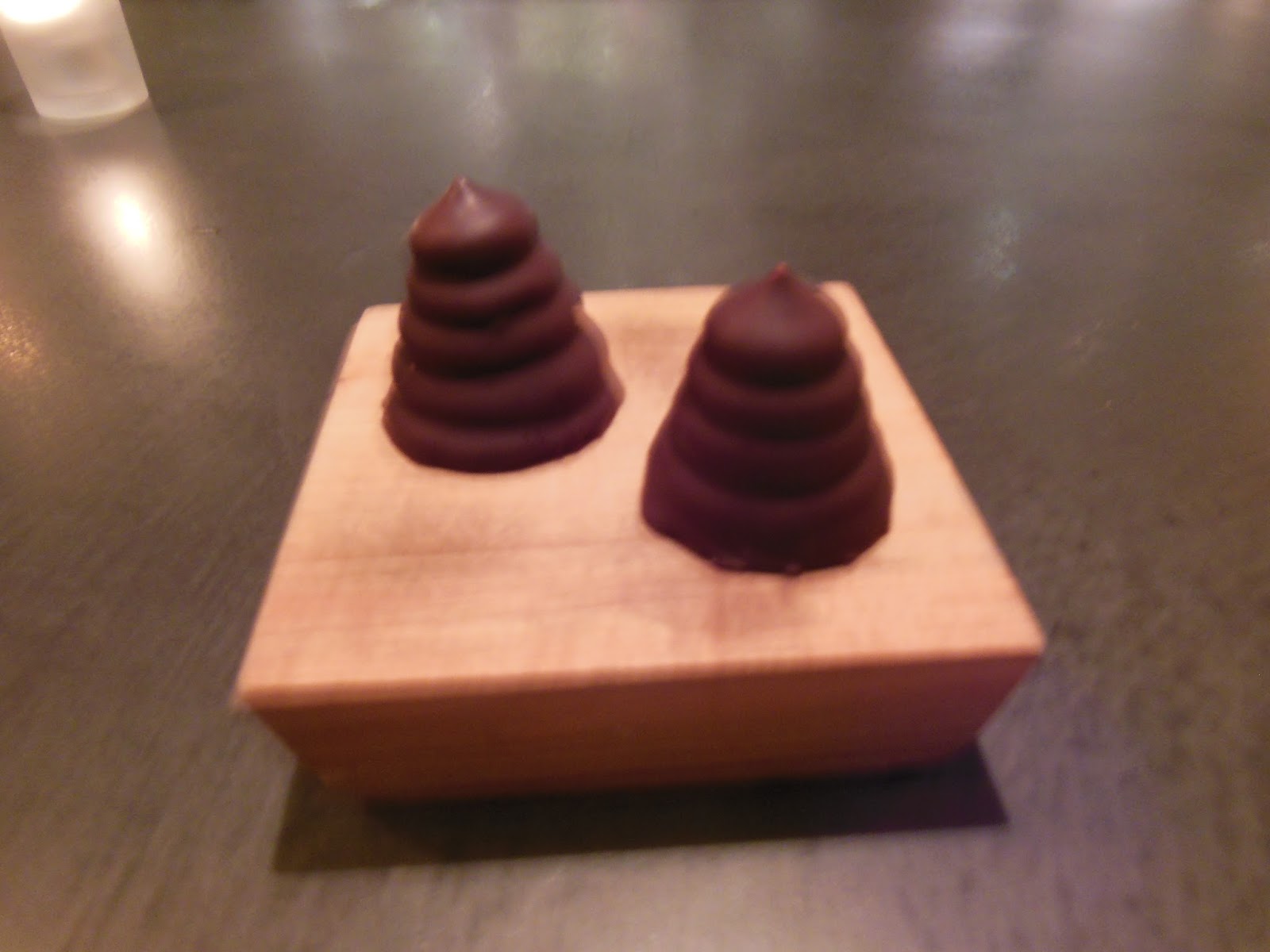
This is the traditional Danish sweet. Two of them with two different flavors, both shaped like chocolate covered spiraled cones. One was with black garlic flavored cream on a layer of pistachio cream and chocolate cookie at the bottom. The other was with beet cream and you can see the light red color in the middle once you bit on it.

After the dinner, I had an escorted tour of their back-kitchen operation in the basement. It has each dry ingredient labeled in a plastic container and placed on the shelf. Things were neat and organized. What surprised me most was their greenhouse. There are at least 80+ varieties of herbs growing in the green house. Nordic people are very adaptive at growing fresh produce in the green house to overcome the inconvenience from cold climate. Since chef Ronny is from Copenhagen, he migrated the Nordic practice to NYC. He even kept a few fans to ventilate the air in the greenhouse because Nordic people believe in the stimulus from the wind can make produces’ stems stronger. Customers may not know they have got the best quality of herbs and produce served in their plates when dining at Atera. I have visited quite a few Michelin starred restaurants back-kitchen facility and have not found any other restaurant have greenhouse facility. With the quality, technical expertise, elaborate presentation and creativity offered to customer, Atera is an under-appreciated charm in NYC.

Wednesday, October 15, 2014

Bouley, NYC

Bouley, 9/22/2014, $55/5 Courses Lunch, French
Bouley has undergone a renovation recently. I was eager to see what Chef Bouley did to this classic place. The carpet and upholstery are new although still remains in the same color system of soft light brown and yellow. The raised floral bed was removed to make room for a few more tables. Instead, floral arrangements are used to display the flowers. The ambiance is still elegant, nice and striking. We decided to have the 5-Course Luncheon Tasting Menu for $55.

Amuse Bouche

1.Tomato and Strawberry Soup, Served with cucumber, tomato granitée, soy ice cream and fennel flower.

Chilled strawberries were at the bottom, pickled cucumber was used for another layer and then tomato granitée was placed as the top layer. It offered a very refreshing taste, perfect for a palate opener. To make the dish looks visually more presentable, an adorable Fennel flower was sitting on the top. It reminded me of the flowers usage at San Pau in Spain.

2.Kudzu Bread, Served with potato and cheese purée and topped with truffles.


Potato purée was so smooth and French cow cheese Langres was not so strong but just enough to render the “cheesy” flavor. Kudzu is also called “Japanese Arrowroot”. It’s called gé gēn in Chinese and is considered one of the 50 fundamental herbs in Chinese medicine. Most important, it is a very healthy product and is one type of gluten-free starch thickener. The making of Kudzu bread would take more than two days of work. It involved fermenting of Kudzu root with yeast and sugar for two days. Then, bake the dough into bread. It was a very time-consuming process. Since this item is an Amuse Bouche, it was served with a bite size. I wouldn’t mind to have more bites of it.

Among all the Michelin Starred restaurants that I have visited in NYC, Bouley offers the best selections and quality breads. If you are a gourmet bread fan, you need to starve yourself for a day before you dine in Bouley. The varieties of bread include apricot pistachio, walnut saffron, apple raisin rolls, cinnamon raisin, roasted garlic, roasted onion, rosemary olive, sour dough baguette, sour dough olive etc. To compare with other internationally well-known starred restaurants that I have visited, Bouley is only next to El Raco da can Fabes in Spain in terms of the varieties and quality of bread. Bouley’s breads are all truly gourmet, I would be happy if I just eat Bouley’s bread only. However, I have to refrain myself from eating too much bread when dining in this restaurant because I need to save some stomach room for the good food.

1st Course – Lobster Paté, Lobster Meat, Artichoke Heart and Parsley.

I was going to order “Blini of Scottish Smoked Salmon” from the menu. But, I was offered “Lobster Paté” as a substitute because its kitchen ran out of Smoked Salmon. I had no complaint about the substitute. It was lobster meat slightly seasoned with paprika and mixed with artichoke hearts and parsley, wrapped in Serrano ham, and served with sauce made of tamarind and roasted red pepper purée and passion fruit sauce. The quality and taste of this dish is so perfect and well balanced that a similar dish of “Octopus Pastrami” that I had recently at Batard lost some luster in comparison.

2nd Course - Porcini Flan, Golden Princess crab, black truffle dashi.


I have always been very fond of this dish. Over the years I have chosen this dish nine out of ten times whenever I dined at Bouley. It had a thin layer of egg custard at the bottom. Egg custard was cooked to perfect, tender and smooth. Then, topped with two different types of crabs, left side was Princess Crab and right side was Alaskan crab. Both types of crab meat taste fresh and tender. On top of crab meat was chopped Porcini mushroom. The taste was fabulous, the preparation was perfect.

3rd Course A - Organic Long Island Duck, Organic Golden Nevada Dates, Hudson Valley Hand Milled Polenta.


Only duck breast was used in this dish. It was prepared according to my instruction of “medium rare”. It was served with wheat berries, duck prosciutto, Japanese turnip. Sauce had a strong taste of date. Mashed potato was served as a side dish. The potatoes were from NY update Finger Lake region. The mashed potatoes were so tasty that it virtually melted in your mouth.

3rd Course B - Slow Braised Kobe Style Beef Cheeks, Blue Kale Gnocchi.


My sister had Kobe Beef Cheeks. It was braised with red wine and adequately seasoned. It was sumptuous and juicy, definitely had a better quality than other types of beef. Kale gnocchi had s slight taste of kale. The mashed potatoes were also served as a side dish. It was another perfect dish.

4th Course - Chilled Coconut Soup, Pineapple granite, 10 exotic fruit sorbet, amaretto ice cream


This course was served as a palate cleanser before the formal desert. Amaretto ice cream had it refreshing almond and liqueur taste and 10 exotic fruit sorbet was wonderful. I could taste the flavor of passion fruit, pineapple, lemon and lime.

5th Course - Hot Valrhona Chocolate Soufflé, White Coffee Cloud, Coffee Ice Cream, Chocolate Mousse
Both I and my sister ordered chocolate plate. Chocolate Mousse was baked with right timing, a bit soft in the center and smooth. I loved the white coffee cloud, with a strong coffee flavor and a bit of vanilla but without the bitter taste on the tongue. This course probably gave me so much caffeine enabling me to go on with good pace for the rest of the day.

Petit Four – multiple flavor of bite-size of candies, including tea flavored chocolate, sesame cracker,
Earl Gray tea flavored chocolate truffle and hazelnut flavored chocolate truffle. They were all visually presentable and palatably superb. 

There are quite a few Michelin starred restaurants in NYC offer prix-fixed lunch; most of them are the 3-course type. Bouley’s 5-course lunch stands out in terms of ultra-attentive services, quality, quantity, variety and value. I am eager to find out any other Michelin starred restaurants offer better valued lunch.   


Monday, July 7, 2014

11 Madison Park, NYC

Eleven Madison Park, 6/28/2014, $225 (excluding taxes & gratuity)/14 Courses, French/Molecular

Eleven Madison Park has been my favorite restaurant in NYC, I somehow like it more than Per Se. I decided that we would have a special occasion at Eleven Madison Park on 6/28/14. I liked to see how much has been changed from my previous visit in Sept. 2013. The menu style remains the same offering prix fixe at $225 for 14-16 courses. Unlike the European fine dining restaurants, amuse bouche at Eleven Madison is not something additional outside the framework of menu; it is part of the 14 courses.

Before we started, each guest was given an envelope. Inside each envelope there was a card with four different flavors indicated. My card had celery, strawberry, cherry, and blueberry. The flavor each guest chose would be the theme flavor for the evening. I chose cherry as my theme flavor.

1st Course – Cheddar, Savory Black and White Cookie with Apple


It was a black-and-white (two-colored) cookie with cheddar cream sandwiched in between two pieces of shortbread, looking vertically, half in cream white and the other half in off black. The texture of the cookie resembled more like shortbread, but, with a much lighter and softer taste. The white part of glaze was made of cocoa butter and the off-black part was made of vegetable ashes. Since cheddar cream was mixed with green apple, it produced a mild taste of cheddar. Both halves of the white and black taste outstandingly well with the cheddar and apple cream.

2nd Course – Oyster, Baked Potato Ice Cream and Caviar


There were two parts for this course. One was a fresh piece of oyster from Elliot, Maine in vinaigrette sauce. The other was baked potato crème fraiche with Royal Sterling caviar. Oyster was very fresh and refreshing in vinaigrette sauce. I recalled I had mashed potato ice cream as a palate cleanser a year ago at L’Astrance. Here at Eleven Madison, potato was used for part of cream as a savory dish instead of a palate cleanser. Creative chefs can use the same ingredient for different purposes. The potato cream was softer than the ordinary cream, but may be because of the potato’s texture.

3rd Course – Morel, Custard with Maine Sea Trout Roe


There was Morel custard at the bottom of the bowl with orange color of Main Sea Trout Roe on the side. Morel mushroom custard was delicious and with the right consistency, gave you a melt in your mouth kind of taste. Main Sea Trout Roe had a mild taste so that not to overwhelm Morel’s taste.

4th Course – English peas, Warmed with Meyer Lemon and Egg Yolk


Peas can be made into a very impressive dish. English peas were from upstate NY. They were so young and tender, served with drops of Meyer lemon juice and cured egg yolks and cute tiny lavender flowers. This peas dish was truly excellent. Last time I had another excellent peas dish was at RyuGin in Tokyo in May 2014. Even if you are not vegetable lovers, you would love this pea dish.

5th Course – Beef, Pastrami with Ramps, Rye, Mustard, and Cherry


NYC is famous for its kosher food. This course imitated the well-known Katz Deli’s sandwiches. I got an open rye sandwich with house made pastrami. There were four pieces of pastrami in the plate, two lean pieces and two marbled pieces. Around the piece of open rye bread, there were drops of flavors made of peas, mustard and lemon drops. Pastrami was excellent in both texture and flavor. Since I chose cherry as my theme flavor for the evening, I got a bottle of house made cherry soda. It was quite flavorful because it had much less artificial ingredients than what you would get from most of the markets.

Around this time, we got our favorite brioche-croissants. They were made from Finger Lake whole wheat flour, so flaky and crunchy on the skin part that you wouldn’t waste a single crumb. They were served with two butters, one ordinary butter and another that was butter mixed with lamb fat with crunchy lamb crumbs on top. I would love to eat half-a-dozen. But, if I do I would problems in finishing the whole meal.


6th Course – Foie Gras, Cured with Orange-Chamomile, White Asparagus and Bitter Almond


It was Hudson Valley Foie Gras served with white asparagus foam. White asparagus foam looked a bit thicker than ordinary foam. On top of the foie gras, there was a piece of almond tuile (thin cracker) and slight caramel sauce. It was a very refreshing. Almond Tuile was a true piece of work, with the nice texture, flavor and fine, thin appearance.

7th Course – Apple, Waldorf salad with Celery, Rhubarb and Walnuts


The original version of Waldorf salad is comprised of three ingredients – apple, celery and mayonnaise. There were two parts for this dish. The 1st part was the salad served with local blue cheese, candied walnut and pickled rhubarb. Our server went thru the whole preparation process from a wheeled cart in front of our table. The 2nd part of this course was soup made of apple and celery, garlic and crouton. There was a small piece of apple jelly rested by the spoon which was placed on a dimple especially carved on the inside of the bowl to hold the spoon’s spot. Soup was excellent, with well-balanced taste and very refreshing.

8th Course – Lobster, Poached with Beets, Ginger and Nasturtium


There were two small chunks of lobster tail poached in butter to keep its tenderness, juice and flavor. They were served with roasted beets (in red color), and dehydrated and then roasted beets (in off-black color). Nasturtium is the largest green leaf in the plate. It is the 1st time that I have ever tasted this vegetable. It did not have a distinctive taste. It might be used for the visual appearance.

It seemed that chef Daniel Humm has adopted more from Noma’s approach of emphasizing the old ways of drying, smoking, pickling and curing, and turning the dial toward the natural world. This new adoption was reflected in a few dishes.

9th Course – Asparagus, Braised with Potato and Black Truffle


This course had some showmanship. One of the chefs came to our table with a pot, sitting inside the pot was a transparent looking ball with about 6-in of diameter. When you looked carefully, there were some sprigs of asparagus at the bottom of the ball. This ball was pig’s bladder. When asparagus were cooked in a sealed environment, their flavor was better preserved. In addition, the flavor from pig’s juice also enhanced asparagus’s flavor. Asparagus was served with black truffle and pork juice, potato purée, and black truffle purée. I enjoyed the taste very much, but, was a bit disappointed because I only got one single sprig of asparagus.

10th Course – Lamb, Broth with Cured Lamb and Watercress Roasted with Lettuce, Garlic and Onion Blossoms


There were two parts in this course. The 1st was lamb broth on a chip. Lamb broth was condensed into jelly form and sat on a piece of chip. Very simple looking, but was very sumptuous. The 2nd part was the trilogy of various parts of young lamb prepared in 3 different ways – shoulder (in square shape), torchon (in round shape), and loin cooked medium rare. Each of the trilogy offers different levels of taste. Shoulder offered the spiciest taste, and loin offered the most tender texture. They were served with braised gem lettuce and onion blossoms.

11th Course – Fresh Cheese, Parsley and Pickled Pearl Onion


The original item was a piece of picnic bread, sausage and a bottle of beer. Since I did not like it when I visited Eleven Madison Park last September, I was offered the fresh cheese course instead. Cow’s milk cheese was from Salem, upstate NY, served with pickled pearl onion and parsley. Fresh cheese was fresh, but, taste was not as full of flavor as the imported ones. Using pickled pearl onion was a brilliant idea to enhance the overall taste.

12th Course – Whey, Sorbet with Caramelized Milk and Milk Foam


This is a very quasi-Noma dish. Unfortunately, the dairy products produced in upstate NY had a different level of acidity from what produced in the Nordic region. Sorbet had an overly strong acidic taste and we were offered to have coconut milk flavored sorbet instead. However, it still did not work out well and was not as balanced as the other dishes.

13th Course – Almond, Baked Alaska with Rum, Caramel and Cherry


A beautifully arranged meringue was set in a plate. Our server set the rum sitting in a small pot on fire and sprinkled plenty of rum around the meringue. The meringue was consequently lit on fire and while some of the alcohol burned off. She sprinkled rum very evenly and slowly to make sure the optimal synergy of all ingredients. Then, the whole plate was returned to the kitchen for serving into the individual plate. When each of us received our individual plate, we noticed that there were candied cherries and toasted almonds scattered around the meringue. You can taste rum in every bite.

14th Course – Brownie Sundae, Marsh Mellow, Vanilla Ice Cream, Salted Caramel


We were asked whether we would like to have more deserts and were offered a chocolate themed dessert. Chunks of marshmallow, vanilla ice cream, salted caramel were all in a thin, edible chocolate bowl. That size of chocolate bowl is difficult to make and handle.

15th Course – Pretzel, Chocolate Covered with Sea Salt


Each of us got a chocolate covered pretzel hung on a rack. It was a simple version of petit-four.

16th Course – Chocolate, Sweet Black and White Cookie with Mint


It looked the same like the starting course, except this one was a dessert, not a savory dish. In a way, each guest made a full trip from beginning to end, from the first black-and-white cookie to the second one.

We were offered the opportunity to visit their kitchen. Because it was Saturday night, kitchen was quite busy that we had to wait. While we were waiting, we were offered another light course of dessert.

Extra Course

Chamomile Cheese Cake with Raspberry Sorbet. Chamomile cheese cake was very creamy and had the taste of chamomile. It was served with raspberry syrup. Raspberry sorbet was very refreshing, especially for a summer night.


Kitchen Tour and Additional Extra Course

When they were ready to show us their kitchen, we were offered a jar of their house made granola comprised of roasted oats, multiple grains, raisins and roasted sliced almond. I have always liked their cereal; it was tastier than other cereals. Once you had the taste of it, other cereals seem to be a bit boring.

As we walked into the kitchen, the 1st thing that I noticed was the reception area has some new counters. Other than that the structure of the rest of the kitchen remained the same (4 major stations) as what I saw last September. We also noticed as the dining hall staff brought in orders he/she would make a loud announcement of the numerical number. In turn, the kitchen staff (one from each station) who received the order would make a simultaneous loud response in French “oui” in quasi-military style acknowledging “YES, we received the order”.

However, they have got something new going this time. They have acquired a vintage ice-shaving machine and reconstructed and tweaked it with some engineering expertise. The machine is able to produce a coarse level of shaved ice. We were thrilled when each of us was offered a cup of freshly shaved ice with apple syrup, apple jack, and jasmine infused cream. It was so good that I had to restrain my urge to request for more. It was surely and truly a happy ending for a wonderful meal in town.


Wednesday, May 21, 2014

Mizutani, Tokyo

May 10, 2014, Mizutani, JPY 20,000 (lunch), Japanese

Mizutani is located between Ginza station and Shinbashi station. But, the Google map that I got indicated to use Shinbashi station exit #3. When I was trying to get out of Shinbashi I found out exit # 3 was closed, therefore, I got out from exit #4. That immediately threw me out of balance. I asked a woman for help. She could not figure out which direction to pursue because she is not a local resident and in turned asked another woman for help. This 2nd woman, a local resident of Ginza, called the restaurant for direction and was able to figure out. She was kind enough to escort me to the restaurant taking a 10-minute walk. After I got out of the restaurant I decided to do window shopping in Ginza and found out it was more convenient to use Ginza station exit 8 (under the famous Mitsucoshi Dept. Store) than to use Shinbashi station. Tokyo beats any other cities in the world in terms of the difficulty and confusion incurred in finding a specific location. 

Mizutani is located on the 9th floor of Juno building in Ginza. There are a max of 10 seats around an L-shaped counter. I was seated at the far end of the long-sided counter right in front of Chef Mizutani’s assistant-chef. Chef Mizutani is a bit friendlier than Chef Jiro although with the same level of un-communicable English proficiency. He made it clear right at the beginning that no photo was allowed on food. Among the customers, there were two Asian women (from Singapore), two Japanese women, and a party of 3 Japanese (two men and one woman), a single Japanese man and me. One Japanese man in the 3-party group could speak English fluently and was able to serve as a translator. This kind act helped to make the atmosphere lighter than the tense atmosphere that I had experienced at Jiro Sushi Roppongi.

Chef Mizutani was a long time disciple of old Chef Jiro before that he set up his own sushi bar. He followed the similar pattern of old Jiro’s legendary soft-handed two-finger technique that pairs fresh nigiri cuts from the Tsukiji fish market with warm and delicate rice. At Mizutani, I noticed the room temperature was a bit higher than the setting at Jiro Sushi Roppongi. I ordered the 17-course tasting menu.

1st Course – Fluke (Hirame)
2nd Course – Gizzard shark (Kohada)
3rd Course – Squid (Ika)
4th Course – Tuna (Maguro)
5th Course – Middle fat tuna (Chu-toro)
6th Course – Fat tuna (Oo-toro)
7th Course – Large scallop (Tairagai)
8th Course – Small bay scallop (Kobashiya)
I truly appreciated the arrangements of two different kinds of scallop served sequentially to let the customer enjoy the similarity and difference.
9th Course - Mantis crab/shrimp
Although it is called mantis crab becaseu if has got crab's strong claws, it actually looks more like shrimp with a long body. Therefore, sometimes it is called mantis shrimp. There are ample amount of eggs (like crab eggs) ensconced in the middle of body running from neck to tail. The texture is a cross-breed between crab and shrimp. I got a photo of baby mantis crab when I visited the Tsukiji  market.


10th Course – Geoduck clam (Mirugai)
11th Course – Needle fish (Sayori)
12th Course – Shrimp (Kuruma-ebi)
Cooked shrimp was tenderer than what I ate at Jiro (son) Sushi Roppongi.
13rd Course – Horse Mackeral (Aji)
14th Course – Abalone (Awabi)
15th Course – Sea urchin (Uni)
16th Course – Sea eel (Anago)
17th Course – Egg Omelet (Tamago)
Mizutani’s tamago was noticeable better than Jiro’s. It had slightly softer and smoother texture than Jiro’s.

During our conversation, I asked my translator of the comparison between Jiro and Mizutani. My translator informed me that he has been a regular customer at Mizutani and prefers Mizutani to Jiro because Mizutani has further refined Jiro’s technique. Although I have never been to old Jiro’s sushi bar to say that I agreed with my translator’s finding, I could at least say that Mizutani (Michelin 3-star) is definitely more refined than Jiro (son) Sushi (Michelin 2-star) Roppongi. Overall, the quality and taste were excellent at Mizutani and I also had the luxury of a more relaxed atmosphere at a more reasonable price. Mizutani doesn't accept any credit card becasue they believe in saving costs and pass along the savings to customers.